Strategy is a Verb
Notes from the Front Line.
By Martin Weigel
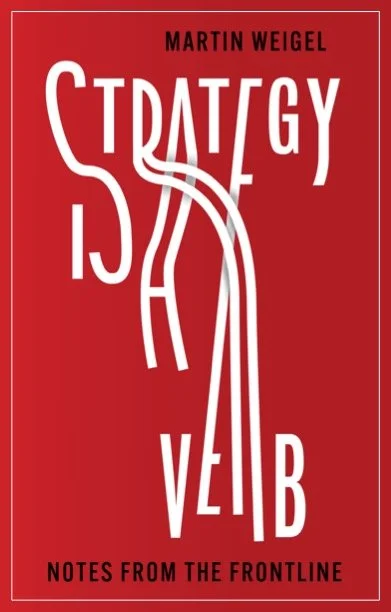
About the Book
We live in a low-resolution, endlessly scrollable world where everything is visible, yet nothing is really seen. No-one is bored. Everything is boring. Optimism is thinned. And for many, wallets even thinner.
Meanwhile, business leaders are grappling with the very real challenges of operating in a non-linear world, where attention is fractured, growth anaemic, and technological disruption threatens everything and has clarified nothing. They are hungry for perspective that matches the scale of that.
And somewhere along the line, strategy got hollowed out - turned into a process, a deliverable, a warm-up act, a set of templates to fill in. The art of the merely feasible, not the art of the necessary or the desired.
Strategy is a Verb: Notes from the Front Line is my attempt to push back against that.
The argument is simple, even if living it isn't: the most urgent task for anyone who cares about brands right now is not to optimise, not to fill space, but to show up with conviction - and build things that are more vivid, more worthwhile, and more valuable. You have to do it on purpose. With conviction. With curiosity. With love. And you have to do it; strategy is a verb.
When she first read the manuscript, my editor called it "quite unusual - philosophical, ontological and, to some degree, practical." I think that's about right.
Structured around 58 verbs - from Cook and Imagine to Struggle, Disobey, Unlearn, and Ignore, it's a collection of observations and provocations drawn from nearly four decades at the front line of creativity, culture, and commerce - from New York and São Paulo to Amsterdam and London.
It's not a how-to manual. No formulas, frameworks, or hacks. No guaranteed pathways to success. No "five secrets of awesome brands I've never worked on" nonsense. Equal parts kindling and kerosene. And a clear articulation of the mental posture strategy demands - imagination over optimisation, judgment over process, conviction over compliance.
The questions the book keeps circling are the ones that have always mattered: How do you make change happen on your own terms? What separates great from merely good? And what does it take to hold meaning in a world that has made peace with noise?
I don't think there are clean and tidy answers to any of them. But I do think asking them - seriously, repeatedly, with some courage - is what strategy actually is.